From Licenses to Lifecycles: AI Agents as the new workforce behind SaaS Growth

The SaaS Mid-Life Crisis
In December 2024, Microsoft CEO Satya Nadella sent a shockwave through the tech world with a single, provocative declaration on the BG2 podcast: “SaaS is dead”. Coming from the leader of a company whose cloud and subscription services generate over $168 billion annually, Nadella suggested that traditional SaaS models would fundamentally “collapse” in the emerging era of AI agents.
The enterprise software industry now stands at an inflection point. Established SaaS vendors face mounting pressure from startups that have abandoned per-seat licensing in favor of consumption-based models. Meanwhile, the applications they have spent decades building have grown so complex that actual user engagement has stagnated.
The problem isn’t that software has lost its value; it’s that the seat-based interfacing has become a bottleneck. Research firm IDC projects that by 2028, pure seat-based pricing will be obsolete – thus, forcing 70% of software vendors to refactor their entire value proposition into new, agent-driven revenue models around consumption, outcomes, or organizational capability metrics.
The issue isn’t that SaaS software is dying; it’s being unbundled, like cable TV gave way to streaming. You still want the content; you just don’t need the 200-channel package to get it. The same is happening with enterprise software: the valuable engine stays, but the clunky interface becomes one of many ways to access it. The data, logic, and workflows that power enterprise operations remain more valuable than ever. What is changing is how organizations access that value.
The answer isn’t replacing your software – it is making it accessible! An intelligent orchestration layer (an “agentic layer”) sits between users and the system, turning complex workflows into simple requests. Agents handle the complexity, make the system easier to use, and unlock value that’s currently stuck behind clunky dashboards. Usage goes up. Value comes out.
Triple the Pressure: Why the Status Quo is Breaking
The Pricing Crisis: Seat-Based Models Under Strain
The traditional per-seat licensing model was designed for an era when software required human operators. That assumption is rapidly eroding.
The Revenue Risk: When a single user equipped with AI tools can do the work of five people, charging per-seat actively punishes customers for improving their efficiency.
The Layoff Factor: Technology sector layoffs exceeded 150,000 positions in 2024 alone, representing seats that simply won’t renew, a structural revenue loss that no price increase can recover.
The Shift to Usage: 85% of SaaS companies have now adopted usage-based pricing (UBP), with hybrid models (subscription + usage) reporting the highest median growth rate in the industry at 21%, outpacing both pure subscription and pure consumption models.
The Adoption Crisis: Complexity as a Barrier
Enterprise software has historically suffered from a steep learning curve. Massive platforms like Workday or Anaplan are built for power users but deployed to everyone, leading to a “shelfware” crisis where 20-39% of SaaS spending is wasted on underutilized licenses. If software is complex, more inexperienced users avoid it, and if they avoid it, the ROI disappears.
The Innovation Bottleneck: Development Velocity
Legacy enterprise roadmaps move in quarters, not weeks. By the time a requested feature ships six months later, the business need has often evolved. This creates a permanent gap between what the business needs and what the software can do. This delay forces teams into manual workarounds and data silos, eroding the very value the SaaS tool was meant to provide.
The Solution: The Agentic Layer
What “Agentification” Means in Practice
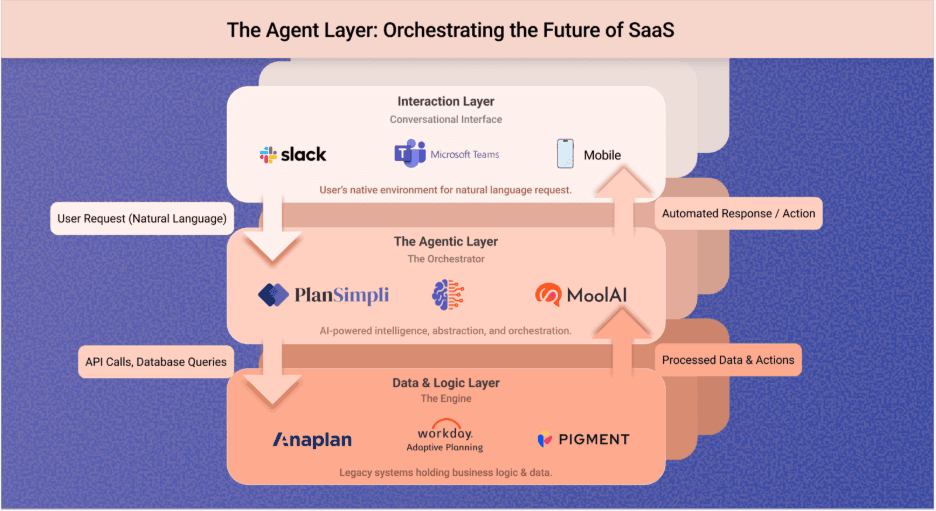
“Agentifying” an application aka building an agentic layer does not require replacing existing SaaS infrastructure. Instead, it means adding an intelligent orchestration capability that sits between users and their enterprise applications. The architectural shift is straightforward:
API over GUI: Agents interact with software through APIs, not complex graphical menus.
Native Integration: Users interact with agents through natural language through tools they already use, like Slack or Microsoft Teams, rather than logging into a separate, specialized dashboard.
Overriding or Removing the Interface Barrier
The value of enterprise software has never been in its buttons and menus. It lives in data models, business logic, and workflow capabilities underneath. When you move the logic for accessing this information into an agent layer, the graphical interface becomes optional -> not mandatory.
This allows for:
Natural Language Interaction: Asking “Show me Q3 variance against forecast” instead of clicking through six menus.
Cross-System Orchestration: One command can query an EPM tool, update a CRM record, and post a summary to a team channel: a coordination that no single-platform interface can provide.
The Usage Unlock
The core business case is simple: If software is easier to use, more people will use it. By removing the friction of a cumbersome interface, agents increase actual engagement. That engagement generates the usage data necessary to justify modern usage-based pricing models.
Gartner projects that 40% of enterprise applications will incorporate task-specific AI agents by the end of 2026, up from less than 5% today
The New Economics: From Access to Outcomes
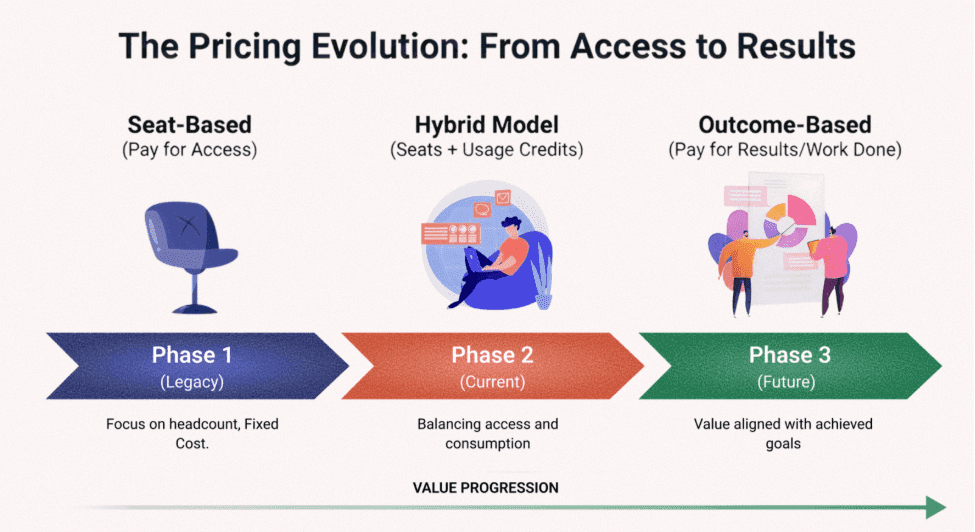
The current pricing shift is not just a move from seat-based models to usage-based ones; it marks a deeper transition from paying for access to paying for results.
The Credit Model Bridge: 2025 saw a 126% YoY7 increase in companies offering “credits,” where customers pay for work completed rather than seats filled.
CFO Alignment: This model aligns vendor and customer incentives. For the customer, it eliminates waste (shelfware). For vendors, consumption revenue offsets the structural erosion of seat-based licensing caused by automation and workforce reduction.
The EPM Opportunity: A Natural Fit
References: https://www.researchandmarkets.com/reports/5785761/enterprise-performance-management-market-report; https://www.appsruntheworld.com/top-10-epm-software-vendors-and-market-forecast/
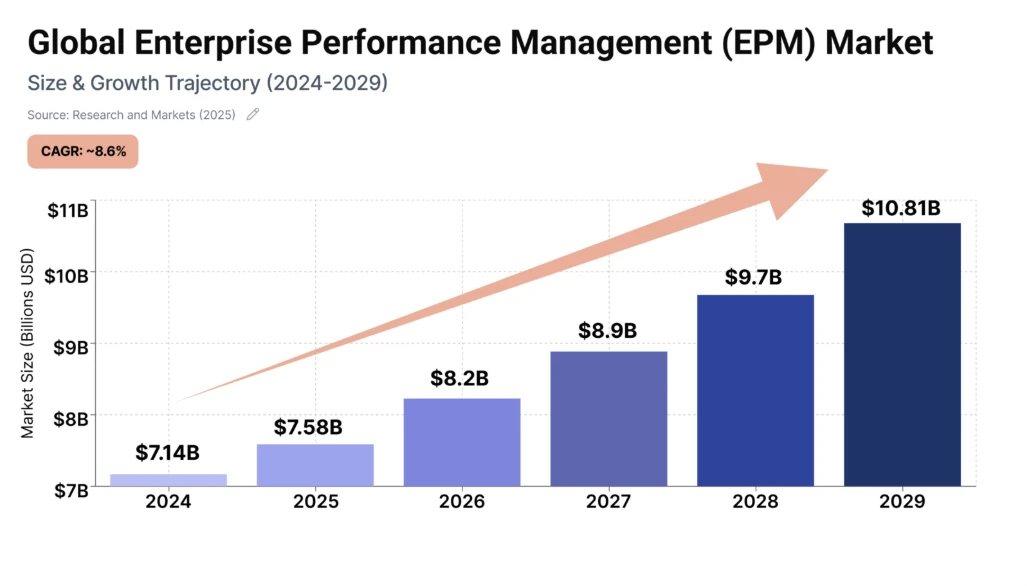
The Enterprise Performance Management market presents an ideal environment for agentic transformation. Valued at $7 billion in 2024 and projected to reach ~$10 billion by 2029, the EPM space combines high-value capabilities with significant adoption challenges.
The Complexity Gap: EPM tools are high-value but low-daily-usage. Finance teams engage with these platforms quarterly or monthly, not daily. The learning curve resets with each planning cycle. Power users become bottlenecks while occasional users avoid the system entirely.
The Incumbent Limitation: While Workday or Anaplan are building their own agents, they are incentivized to keep users inside their own “walled gardens.”
The “Switzerland” Positioning: The real opportunity lies in a vendor-neutral integration layer that can orchestrate workflows across multi-vendor environments (e.g., pulling data from Anaplan to update a Workday budget).
Conclusion: The Path Forward
SaaS is not dying – it is being ”unbundled”! The valuable parts (data models, business logic, workflows) remain essential. What’s changing is how we access them. The cumbersome dashboards and complex interfaces are becoming optional, replaced by intelligent agents that handle the complexity for us.
For Enterprise Buyers: Audit your current utilization. If your “shelfware” waste is high, it’s time to move toward agent-native workflows and usage-based contracts.
The transition from static licensing to dynamic, lifecycle-based engagement represents a defining challenge for Finance and Operations leadership. Through the PlanSimpli and MoolAI partnership, we help organizations bridge the gap between complex EPM software and tangible business value.
PlanSimpli brings extensive EPM expertise and a deep understanding of User Experience. MoolAI brings rich technical understanding and the advanced Agentic Layer. Together, we transform how your team interacts with platforms like Anaplan, Workday, and Pigment. Our approach goes beyond simply building agents; we are delivering a trusted, compliant, and scalable game-changing experience designed specifically to improve software utilization.
By moving cumbersome workflows into familiar interfaces like Slack and Teams, we “agentify” your environment to literally increase usage and transition your costs toward a value-based model. Given that the EPM market is forecasted to grow steadily to ~$10B+ by 2029, implementing this trusted layer now is essential for capturing future growth.
What sets us apart: Our agents have built-in guardrails. Every action is evaluated against your policies before it executes. This drives higher usage and protects the underlying system—agents cannot take actions that would harm your EPM environment. This isn’t a chatbot with API access. It’s a governed, compliant, enterprise-ready layer.
Do not let your high-value EPM investment become shelfware. Contact us to audit your current digital friction points and develop a roadmap that transforms your complex SaaS stack into a responsive, agent-driven growth engine.
Build agents. Trust their outputs. Scale confidently.
MoolAI ensures every AI agent is reliable, governed, and ready for enterprise deployment.
Book your Demo
