Change Management for Conversational EPM: Moving Beyond the Planning Team

Enterprise Performance Management systems are powerful. They drive budgeting, forecasting, scenario modeling, and performance visibility across organizations. The global EPM software market reached $7 billion in 2024, growing 13.7% year-over-year.[1] Yet in most companies, the insights these platforms generate remain locked behind specialized interfaces that only a handful of trained users can navigate.
According to the Association for Financial Professionals’ 2025 Benchmarking Survey, 71% of organizations have EPM tools, yet spreadsheets continue to dominate for planning and forecasting.[2] The problem is not the platform. It is the access model. Department leaders wait days for variance explanations. Finance teams spend the majority of their time fulfilling data requests rather than performing strategic analysis. Expensive licenses remain underutilized.
Conversational EPM changes that dynamic - not by replacing your EPM system, but by making it accessible to the people whose decisions depend on it.
The Real Bottleneck in Enterprise Planning
The typical EPM access cycle works like this: a business leader needs insight, say, “Why did Q3 marketing overspend?” The request goes to FP&A. A report is built or customized. The answer arrives days later. The FP&A Trends Group found that only 18% of organizations can run planning scenarios in under one day, with 49% taking longer or being unable to run them at all.[3] Multiply that latency by dozens of weekly requests, and finance becomes a reporting service desk rather than a strategic partner.
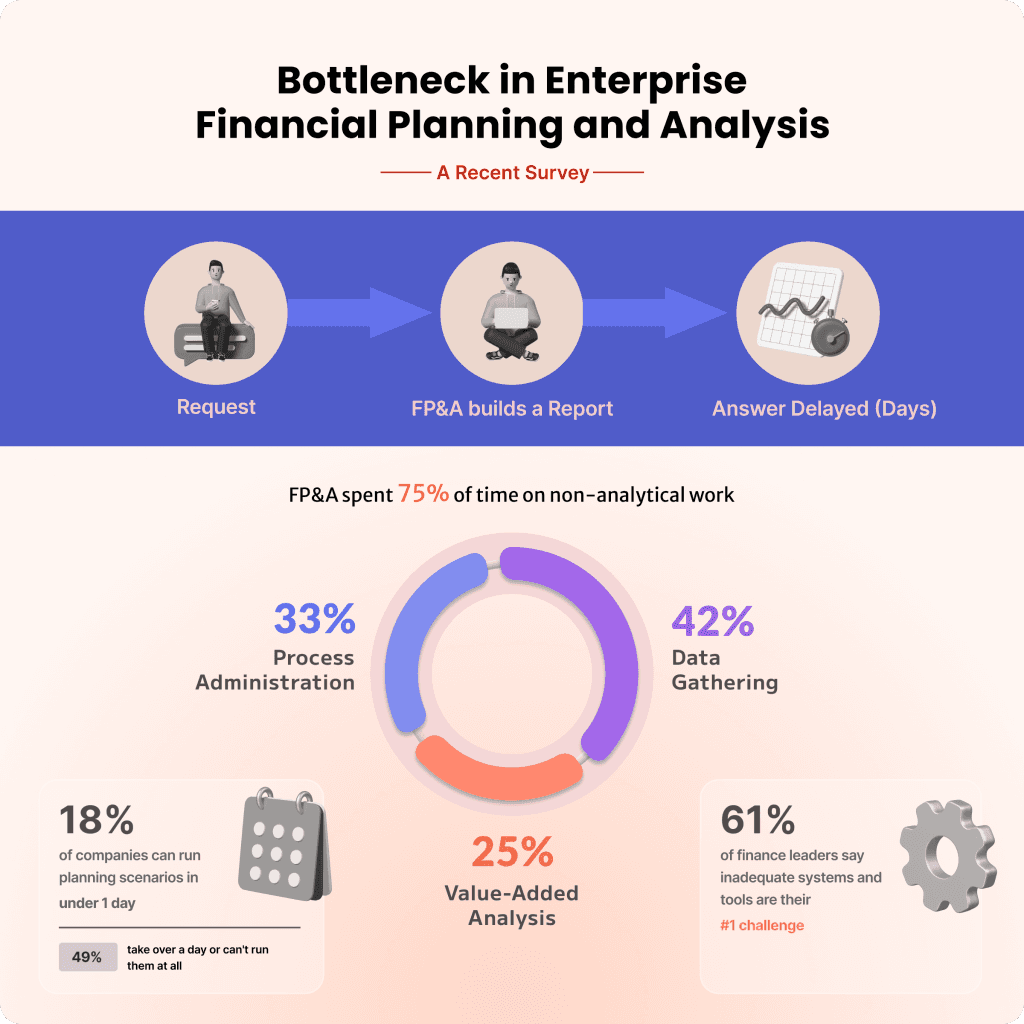
The capacity cost is substantial. A joint survey by the Association for Financial Professionals and APQC found that FP&A professionals spend only 25% of their time on value-added analysis. The remaining 75% goes to data gathering (42%) and process administration (33%). Furthermore, 61% of finance leaders identified inadequate systems and tools as their department’s most pressing challenge.
The capacity cost is substantial. A joint survey by the Association for Financial Professionals and APQC found that FP&A professionals spend only 25% of their time on value-added analysis. The remaining 75% goes to data gathering (42%) and process administration (33%). Furthermore, 61% of finance leaders identified inadequate systems and tools as their department’s most pressing challenge.[4]
Illustrative Capacity Cost Model Consider a mid-size planning team that handles 30 ad-hoc requests per week, each averaging 45 minutes, at a loaded cost of $80 per hour: |
Metric | Value | Strategic Implication |
|---|---|---|
Weekly ad-hoc requests | 30 requests | Each request defers a strategic analysis task |
Average time per request | 45 minutes | Analyst-grade capacity consumed by extraction work |
Blended loaded cost per hour | $80 / hour | Senior FP&A analyst equivalent |
Annual hours consumed | 1,170 hours | ~0.6 FTE dedicated to report fulfillment |
Annual capacity cost | $93,600 | 1,170 hours that could be redirected to M&A analysis, capital allocation, or scenario modeling |
At 60% Conversational Automation | Value | Strategic Value Unlocked |
|---|---|---|
Requests handled conversationally | 18 of 30 / week | Business users get answers in seconds, not days |
Annual FP&A hours recaptured | 702 hours | Equivalent to adding a half-time senior analyst |
Capacity value reclaimed | $56,160 | 702 hours redirected from extraction to strategic modeling, scenario analysis, and board-level advisory work |
This hypothetical illustration does not include the downstream value of faster decision cycles, reduced opportunity cost from delayed insights, or improved decision quality from broader access to planning data. The 60% automation rate is illustrative; actual rates depend on query complexity and data model maturity.
What Conversational EPM Actually Does
Conversational EPM adds a secure natural language access layer over your existing EPM platform, whether that’s Workday Adaptive, Pigment, Anaplan, OneStream, or Oracle EPM. Instead of submitting a ticket, a department leader can ask a question in plain language and receive a structured response: line-item breakdowns, driver attribution, historical comparisons, and contextual explanation. Not through a new dashboard. Not through complex modeling. Through a direct query that translates into the exact platform-native operation the planning team would build manually.
Every interaction is logged as platform usage, reinforcing the value of the existing EPM investment. As Wipro’s Charles Wilson noted in Board International’s 2025 Trends report: “GenAI solutions need to be embedded into daily workflows, not siloed with data scientists.”[5] Conversational EPM operationalizes that principle for planning data.
How It Works with the Platforms You Already Use |
|---|
Workday Adaptive Planning: Conversational access lets business users query Adaptive’s planning models, retrieve forecast data, and explore variance drivers without navigating Adaptive’s interface or waiting for FP&A to build custom views. Budget owners can ask “Show me Q3 forecast variance by cost center” and receive a governed, role-filtered response in seconds, pulling directly from Adaptive’s data model. |
What About Vendor-Native AI?
If you’re thinking “my EPM vendor is already adding AI,” you’re right. Oracle now embeds AI throughout its Cloud EPM suite. SAP has launched Joule, a conversational AI copilot with autonomous agent capabilities across finance and supply chain workflows.[6] Anaplan is advancing natural language interfaces for scenario planning, and Planful is building conversational agents for business users.[7]
These are valuable capabilities, and they validate the market direction. But they come with a constraint: they only work within their own ecosystem. Vendor AI rollouts are incremental, often gated behind premium licensing tiers, and limited to a single platform’s data model. For organizations running multiple EPM platforms, or those not ready for a costly platform upgrade, a platform-agnostic conversational layer delivers the same access benefits without requiring you to consolidate vendors, purchase additional AI modules, or wait 12–24 months for your vendor’s roadmap to mature.
In Practice: Sales Operations
Consider a typical Sales Operations team that depends on weekly forecast breakdowns from FP&A. In most organizations, this follows a familiar cycle: Sales Ops submits a request. FP&A manually extracts data from the EPM platform, applies the relevant filters, formats it for the audience, and delivers the report. Turnaround: three to four days. Planning team cost: eight to ten hours per week for this one consumer alone.
With conversational EPM, a Sales Ops director opens Slack or Teams on Monday morning and types: “Show me the Q3 sales forecast by region with variance to plan.” Within seconds, the conversational layer translates that into the platform-native query, applies the user’s role-based permissions, and returns a structured response: forecast by region, variance breakdown, and comparison to the prior quarter. The Sales Ops director can follow up immediately: “Drill into APAC, what’s driving the shortfall?” The system responds with driver attribution, without a single email to finance.
The impact is measurable. The majority of routine, recurring requests become self-service. Finance’s time shifts from extraction and formatting to strategic scenario modeling, the work they were hired to do. And every query is logged, auditable, and governed by the same permissions as the underlying platform.
That’s not automation replacing finance. That’s finance operating at a higher level.
Why This Is a Change Management Challenge
Conversational EPM succeeds or fails based on adoption, not technology. And the adoption environment is harder than it looks. Gartner reports that finance teams’ ability to absorb change has declined 50% year-over-year ,[8]while PwC found that 70% of CFOs cite already-demanding workloads as a key barrier to adopting new technology.[9] This means any new initiative that feels like “one more thing to manage” will stall, regardless of its technical merit.
The organizations that succeed with conversational EPM share three implementation principles:
Frame It as Amplification, Not Disruption
Position conversational EPM as capability expansion. Planning teams gain capacity for strategic work. Business leaders gain direct access to intelligence. The EPM platform gains higher utilization metrics. No one loses their role, their tools, or their authority. The 2024 FP&A Trends Survey found that 64% of respondents now rely on data for decision-making, a 12% increase from the prior year[10], the appetite for data access is already there. Conversational EPM simply removes the friction.
Start with a Defined Pilot Scope
Begin with one function, ten recurring planning questions, and clear baseline metrics. Measure time-to-insight, report request volume, and planning team capacity allocation before deployment so you can demonstrate concrete improvement afterward. Resist the temptation to launch enterprise-wide. Narrow pilots generate sharper data, faster adoption, and more credible internal case studies for expansion.
Enforce Governance from Day One
Planning democratization does not mean uncontrolled access. Every deployment must include role-based access control (inherited from the EPM platform), complete query logging, data masking for sensitive elements, and full auditability. Finance gains leverage - routine reporting declines while strategic modeling increases, but only if governance is non-negotiable from the start.
Key Principle: Planning democratization ≠ uncontrolled access. Every expansion of access must be matched by proportional governance.
What We’ve Learned from Early Deployments
Data complexity is real - scope accordingly. Conversational systems rely on your existing data model. Proper configuration and metadata alignment are critical, and this work should not be underestimated. The most successful deployments start narrow, a single business unit, a defined set of query types, and expand incrementally as confidence grows.
Conversational access increases EPM usage; it does not cannibalize it. EPM usage among organizations with lower accessibility barriers grew from 34% to 62% in a single year – a 28 percentage-point jump.[11] Every natural language query translates into a platform-native operation. The EPM investment gets more valuable, not less.
Finance teams welcome it when positioned correctly. Gartner’s 2024 survey found that AI can automate 40–60% of FP&A activities such as data gathering, reconciliation, and basic reporting.[12] When planning teams see conversational EPM as a tool that removes their lowest-value work, adoption follows naturally. When it’s positioned as oversight or replacement, resistance is predictable.
Measuring Success
Disciplined measurement from day one is non-negotiable. Track four core metrics
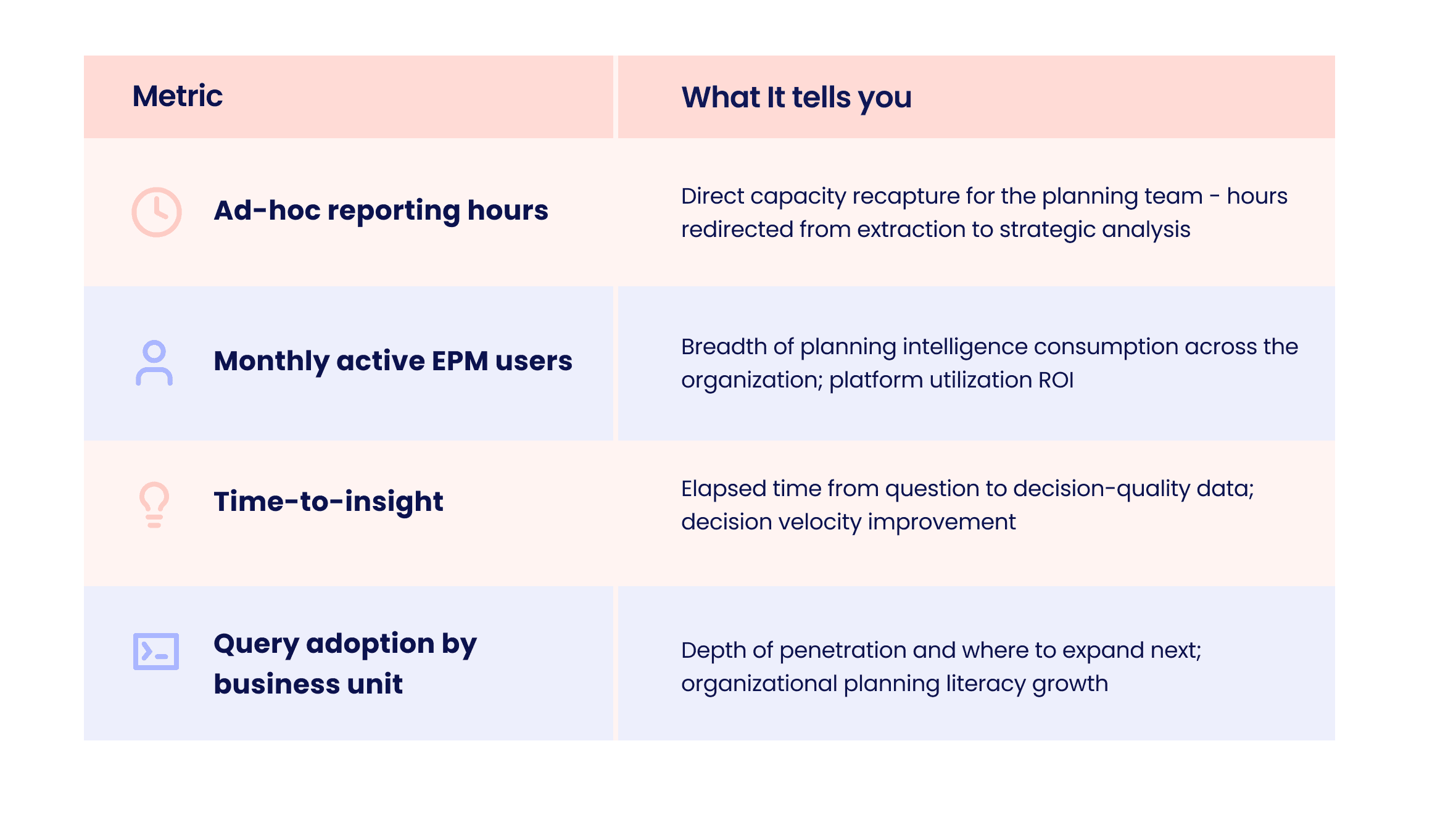
Industry benchmarks provide useful context: organizations implementing AI in planning report up to 25% reduction in planning costs and 33% shorter budget cycles.[13] McKinsey’s 2024 research confirms that high data quality correlates with significantly stronger forecasting performance.[14] Your own pilot data will ultimately be more persuasive than any external benchmark, which is precisely why baseline measurement matters.
The Bigger Opportunity
EPM systems are built for structured planning. Conversational access makes them usable across the enterprise. Organizations that adopt this model do not just move faster; they make planning data part of everyday decision-making, at every level, in every function.
The conversational AI market is projected to reach $41.4 billion by 2030[15].The question is not whether natural language access to enterprise planning data will become standard. It is whether your organization will be among the first to realize its value, or among those still waiting on the report queue.
Ready to Explore Plangentic’s Conversational EPM? Contact us to learn more about what conversational EPM can do for you!
References
[1]Apps Run The World. “Top 10 EPM Software Vendors, Market Size and Forecast 2024–2029.” July 2025. Global EPM market: $7B in 2024, +13.7% YoY. appsruntheworld.com/top-10-epm-software-vendors-and-market-forecast/
[2]Association for Financial Professionals (AFP). “2025 AFP FP&A Benchmarking Survey Report: Technology & Data.” Finding: 71% of respondents have EPM tools, yet spreadsheets remain dominant. Reported via SoftwareConnect, November 2025.
[3]FP&A Trends Group. “The FP&A Analytics Playbook: Moving to Intelligent Planning.” 2025. Finding: Only 18% of organizations can run scenarios in under one day; 49% take longer or cannot run them at all. fpa-trends.com/article/fpa-analytics-playbook-moving-intelligent-planning
[4]Association for Financial Professionals (AFP) / APQC. “FP&A Benchmarking Survey.” Finding: FP&A professionals spend only 25% of time on value-added analysis (42% data gathering, 33% process administration); 61% cite inadequate tools as their top challenge. Reported via Vena Solutions, July 2023.
[5]Board International. “2025 Trends in Enterprise Planning.” March 2025. Quote from Charles Wilson, Wipro. board.com/guide/2025-trends-in-enterprise-planning
[6]CMSWire. “SAP Introduces Conversational AI for Complex Enterprise Ops.” February 2025. SAP Joule AI copilot and autonomous agent capabilities. cmswire.com/customer-experience/saps-new-ai-agents/
[7]Apps Run The World. “Top 10 EPM Software Vendors, Market Size and Forecast 2024–2029.” July 2025. Vendor AI capability analysis: Anaplan NL interfaces, Planful conversational agents.
[8]Gartner. “Finance Transformation Survey.” 2024. Finding: Finance teams’ change absorption declined 50% year-over-year. Reported via Cube Software, April 2025. cubesoftware.com/blog/fpa-statistics
[9]PwC. “Global CFO Survey.” 2024. Finding: 70% of CFOs cite already-demanding workloads as a barrier to new tech adoption. Reported via Cube Software, April 2025. cubesoftware.com/blog/fpa-statistics
[10]FP&A Trends Group. “2024 FP&A Trends Survey Results.” Survey of 2,400+ practitioners. July 2024. Finding: 64% of respondents rely on data for decision-making (+12% YoY). fpa-trends.com/article/2024-fpa-trends-survey-results-unveiled
[11]Dresner Advisory Services. “EPM Market Study.” 2024. Corroborated by Abacum: EPM usage among small organizations grew from 34% to 62% in one year. abacum.ai/blog/enterprise-performance-management
[12]Gartner. “2024 Finance AI Survey.” Finding: 58% of finance departments now use AI (+21pp from 2023). AI automates 40–60% of FP&A activities. Reported via Abacum, 2024.
[13]Phoenix Strategy Group. “FP&A Prioritization: Strategies for Better Time Use.” 2024. AI reduces planning costs by up to 25%, shortens budget cycles by up to 33%. phoenixstrategy.group/blog/fp-a-prioritization-strategies-for-better-time-use
[14]McKinsey & Company. “The State of AI in 2024: Gen AI Leaps Forward.” May 2024. Finding: High data quality correlates with significantly stronger forecasting performance. mckinsey.com/capabilities/quantumblack/our-insights/the-state-of-ai
[15]Grand View Research. “Conversational AI Market Size, Share & Trends Analysis Report.” June 2025. Market: $14.29B (2025) to $41.39B (2030), 23.7% CAGR. grandviewresearch.com/industry-analysis/conversational-ai-market-report
Build agents. Trust their outputs. Scale confidently.
MoolAI ensures every AI agent is reliable, governed, and ready for enterprise deployment.
Book your Demo
