Agentic EPM: Extending sustainability for intelligent Enterprise Performance

Finance leadership teams across enterprises strongly support end-to-end automation for planning and forecasting. However, as automation scales, reliability comes under pressure. Accuracy and precision are compromised while processing vast volumes of data. In this landscape, outcomes cannot be driven by data alone; they must be guided by insight-based reasoning, requiring scenario analysis that extends beyond raw numerical outputs.
Also, AI automation does not consistently embed governance and traceability by design. When these controls are missing, automation remains incomplete, producing results that lack explainability, accountability, and, ultimately, confidence for finance leaders.
In this blog, we explore what AI sustainability means from an enterprise leadership perspective. Also, learn how MoolAI and PlanSimpli work together in extending the capabilities of Agentic EPM to deliver a sustainable Enterprise ecosystem
Why should Agentic EPM remain sustainable?
AI adoption for intelligent automation is accelerating rapidly across enterprises. According to the 2025 McKinsey & Company Global AI Survey, more than 70% of organizationsnow use AI in at least one business function, with finance forecasting emerging as one of the most active areas of adoption. This momentum is expected to intensify, as 62% of business leaders plan to increase AI investment in the near term.
However, scale alone does not guarantee impact. While 86% of enterprises report AI embedded in operations, only 19% routinely mandate explainable outputs, and fewer than 25% report having a formal AI governance program. This growing imbalance between adoption, investment, and governance is especially critical in finance, where forecasting accuracy, traceability, and confidence directly influence executive decisions and stakeholder trust.
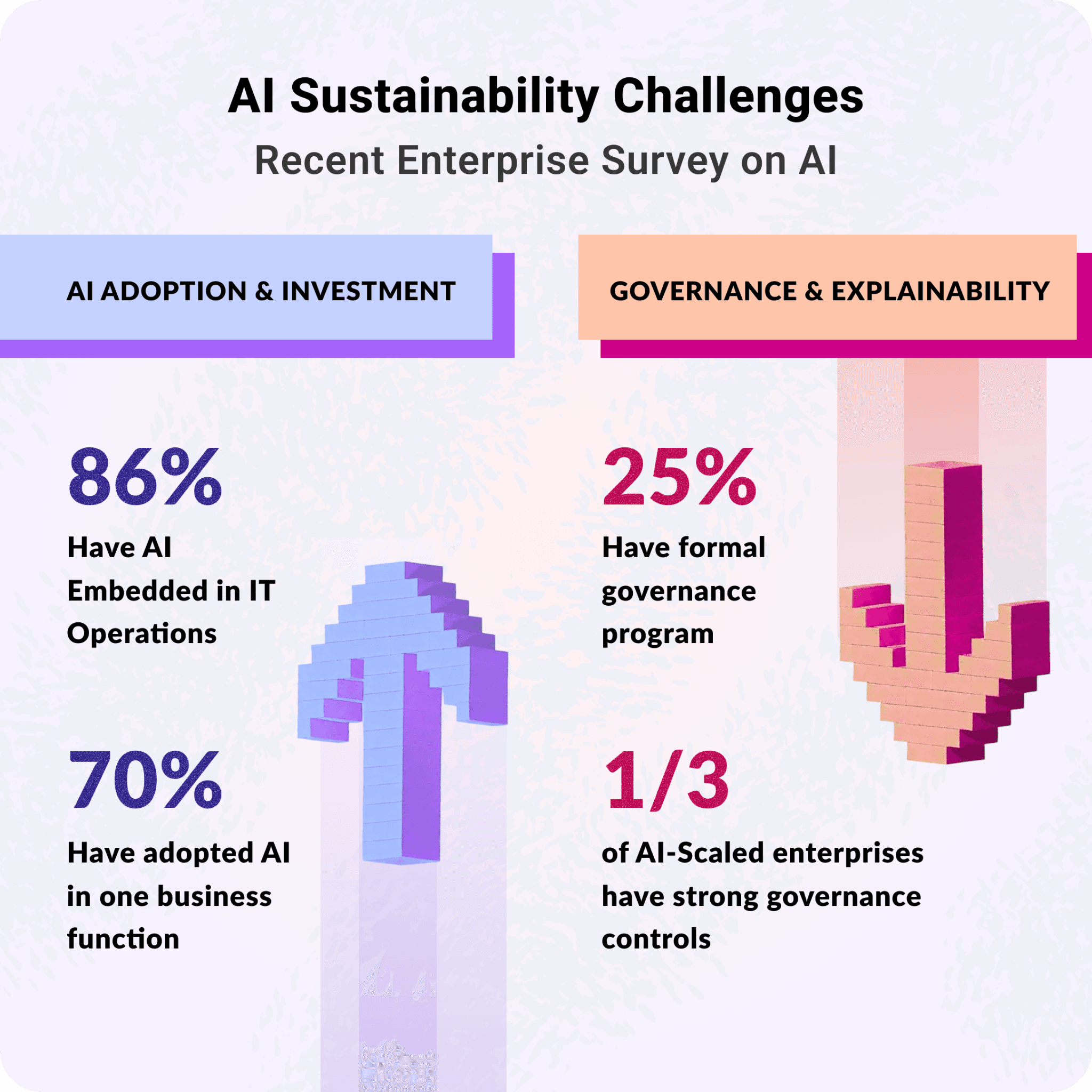
Sustainable Agentic EPM addresses these gaps by enabling decision sustainability withthe ability to generate consistent, explainable, and governed forecasts without exhausting leadership capacity. It ensures that autonomous agents do more than calculate outcomes; they operate within structured governance frameworks, align recommendations with business context, and preserve human judgment where it matters most.
Ultimately, sustainability in Agentic EPM is what transforms AI from a high-speed automation tool into a trusted decision partner. It allows enterprises to scale forecasting intelligence responsibly, deliver speed, confidence, and long-term value without compromising trust, accountability, or strategic focus.
Top Five Areas to Focus on for Sustainable Agentic EPM
Sustainable agentic Enterprise Performance Management (EPM) is not just about deploying intelligent agents; it’s about ensuring they operate with consistency and accountability, aligning long-term business goals. Below are five critical areas Enterprises should prioritize to build Agentic EPM systems that plan, implement, forecast, and scale.
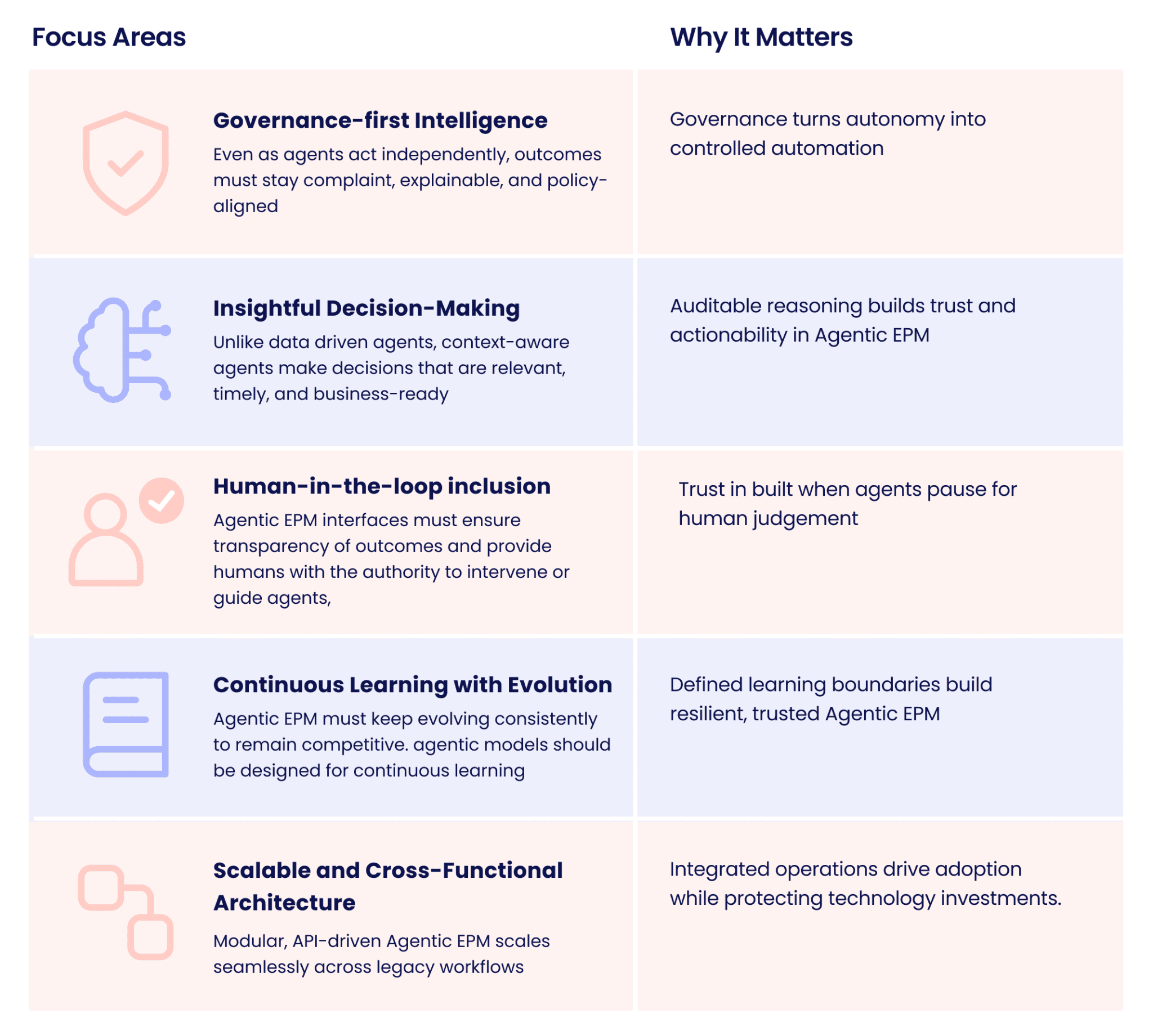
Governance-First Intelligence: Agentic EPM should be built with governance embedded from day one, not bolted on later. Autonomous agents should operate within clearly defined guardrails; setting roles, decision rights, approval restrictions, audit trails, and accountability. This ensures that as agents act independently, their outcomes remain compliant, explainable, and aligned with Enterprise goals and policies.
Why it matters: Without governance, automation turns into a risk. Sustainable EPM bridges the gap between autonomy and control.
Insightful Decision-Making: Agents should not act on data alone. They must interpret data through the lens of business context, including organizational hierarchies, financial constraints, planning cycles, regulatory requirements, and strategic priorities. With this context, agents generate decisions and recommendations that are relevant, timely, and ready for execution.
Why it matters: When recommendations are not merely data-driven but backed by clear, auditable reasoning, EPM produces insights leaders can trust, and teams can act with confidence.
Human-in-the-loop inclusion: Agentic EPM should augment human decision-making, not overwhelm or replace it. Interfaces must ensure transparency of outcomes and provide humans with the authority to intervene or guide agents, thus extending capabilities that are essential for long-term adoption.
Why it matters: Trust is built when agents pause human input in situations that require judgment. This enables enterprise users to adopt AI confidently for reliable, governed EPM solutions.
Continuous Evolution with Controlled Learning: Agentic EPM needs to expand into new dimensions, evolving consistently to remain competitive. Agentic models should be designed for continuous learning, aligned not only to feedback but also to evolving market shifts; aligned not only with feedback but also with ongoing market shifts. However, learning must remain structured. Models, rules, and workflows require version control, validation, and performance monitoring.
Why it matters: Agentic EPM must learn within defined boundaries. Governed learning ensures resilience, reliability, and long-term enterprise confidence.
Scalable and Cross-Functional Architecture: A sustainable Agentic EPM ecosystem should integrate seamlessly with legacy planning, implementation, and forecasting systems. Modular, API-driven architectures enable agents to scale across finance, operations, and sales without creating silos. This approach empowers the existing workforce while minimizing training efforts.
Why it matters: Integrated, cross-functional operations create a seamless transition through change, accelerating long-term adoption while safeguarding technology.
Why Agentic EPM Requires a Sustainable Approach – The Human Factors
Agentic EPM focuses on insight-based recommendations driven by reasoning and logic. As humans work alongside multiple agents, the decisions made must align with human perception and understanding, making a sustainable ecosystem essential.
A sustainable approach ensures Agentic EPM -strengthens human judgment rather than replacing it, while preserving human intervention at every stage where it matters.
Here are a few important human factors that raise concerns when adopting AI agents to ensure EPM sustainability and ways to responsibly account for the human element.
Cognitive Capacity and Reasoning:
Agentic AI can process vast volumes of data and make decisions by testing multiple logical assumptions. However, too many alerts and too much noise can interrupt the workforce’s thinking and overwhelm human cognitive bandwidth.
Train Agentic EPM to deliver optimized outcomes through prioritized, insight-based recommendations that support intelligent decision-making.
Explainability and Trustworthiness:
When Agentic EPM is used for financial planning and forecasting, data, logic, and assumptions must consistently produce accurate outcomes. In finance, even minor deviations in facts and figures during automation can lead to a loss of trust. Therefore, traceability must be guaranteed at every stage.
Make data driven recommendations fully explainable and easily understandable for accurate decision making.
Human Inclusion and Accountability:
Approvals and clearances are highly sensitive for finance teams, and insufficient human oversight can lead to data discrepancies. When authenticity in recommendations and forecasting is compromised, strategic intent is put at risk. Unclear ownership further complicates these issues, creating challenges in traceability.
Clearly define human authority and intervention rights and embed them as a part of sustainable Agentic EPM.
Workforce preparedness for Change:
Automating EPM with extended Agentic AI capabilities to overcome limitations in legacy systems represents a strategic evolution. Upskilling, training, or redeploying the existing workforce to keep pace with continuously evolving Agentic AI capabilities enables seamless transitions and swift alignment with the system.
Configure Agentic EPM at the foundation level to record updates and trigger corresponding learning programs, enabling immediate operational preparedness.
Emotional Acceptance and Long-Term Adoption:
When an operational system is extended or transformed, it inevitably brings a cultural shift that requires the workforce to feel emotionally supported. Employees must feel respected and empowered; otherwise, they may bypass established procedures, leading to incomplete adoption. This often results in only partial upgrades to legacy systems and, consequently, unfulfilled outcomes.
Extend Agentic EPM capabilities to account for the workforce’s emotional compatibility, enabling smoother adoption of system shifts and upgrades.
Orchestrating Enterprise Workflows for Sustainable Agentic EPM
Enterprises often navigate challenges related to talent availability, regulatory adherence, and continuous change, making long-term resilience imperative. Extending EPM capabilities with Agentic AI involves processing and managing vast volumes of data and assumptions. In this context, enabling human judgment is essential to address conflicting outcomes. Sustainable EPM workflows therefore, become the foundation, not an add-on.
Below are a few orchestration strategies to enable sustainable Agentic EPM and build trust and reliability.
Integrate cross-functional teams to operate in unison, preventing breakdowns that lead to chaos and siloed decision-making.
Reduce cognitive overloads by training gents to handle data analysis, logical reasoning, and scenario modeling; and humans to frame strategies and make resolutions.
Embed Agentic layers for governance through transparency and accountability, enabling clear traceability and answerability during compliance audits.
Eliminate workforce strain by minimizing manual reconciliation and accelerating decision cycles.
Enhance team collaboration through real-time insights and unified business functions that orchestrate end-to-end workflows.
Sustainable Agentic EPM enables a human-centric ecosystem where productivity and collaborative intelligence thrive, supported by emotional security and shared team purpose.
The PlanSimpli-MoolAI Partnership: Extending Agentic Capabilities for a Sustainable EPM
The PlanSimpli – MoolAI partnership delivers Plangentic, a sustainable Agentic EPM architecture designed to support leadership with clarity, accuracy, and decision confidence. By orchestrating intelligent agents across planning, forecasting, and performance management, the partnership reduces reasoning fatigue caused by complex analyses and fragmented decision cycles. It transforms enterprise data into clear, explainable insights, accelerates scenario-driven decision-making, and produces presentation-ready outputs leaders can trust. With adaptive, governed automation and agent-supported forecasting, MoolAI and Plansimpli enable enterprises to scale performance management without compromising cognitive capacity, well-being, or long-term strategic focus.
Although AI is now a core component of enterprise workflows, most organizations still lack the governance and oversight mechanisms required to ensure reliable, ethical, and explainable outcomes.
These gaps are particularly critical in Finance and Executive leadership roles, especially for CFOs and COOs. Delivering inaccurate or unreliable forecasts to stakeholders leads to delayed decisions, erodes trust, and demands frequent human intervention. Over time, this disrupts cognitive balance and strategic focus.
AI automation, when driven by weak governance and poor-quality insights, ultimately limits actionability.
Are you looking for an EPM solution that is traceable, governed, and compliant, while safeguarding C-suite sustainability?
Contact us for a demo today!
Contact us for a demo today!
Table of contents
Why should Agentic EPM remain sustainable?
Top Five Areas to Focus on for Sustainable Agentic EPM
Why Agentic EPM Requires a Sustainable Approach – The Human Factors
Orchestrating Enterprise Workflows for Sustainable Agentic EPM
The PlanSimpli-MoolAI Partnership: Extending Agentic Capabilities for a Sustainable EPM
Contact us for a demo today!
Build agents. Trust their outputs. Scale confidently.
MoolAI ensures every AI agent is reliable, governed, and ready for enterprise deployment.
Book your Demo
