POC: The Curtain Raiser Before the Real Product Kicks Off

We are living in an era of customization. Gone are the days of building a stereotypical product and demonstrating every process through a one-size-fits-all approach.
AI automation works differently. It adapts to each user’s business environment by analyzing their data, workflows, processes, and deliverables to build solutions tailored to the organization’s needs.
And this is where the Proof of Concept (POC) becomes critical.
This article explores what a POC looks like, why it is critical when building agentic systems, and how to take one from a rough prototype to something reliable enough for production.
What is POC (Proof of Concept)?
A POC is not just a demo. It is a miniature working model ideated, built, coded, and activated to prove that the solution can function effectively in a real business environment. Its purpose is to convince the user that, when scaled, the system can seamlessly automate business functions and deliver measurable value.
For agentic AI and increasingly autonomous workflows, this jump from idea to a working module has quietly become the most important checkpoint between what we hope to build and what we can run. It is the stage where engineering teams either earn the confidence to move forward or uncover hard truths that send the design back for another round of refinement.
Hence, a POC becomes a necessary and important milestone in building trust that reliable and scalable automation can be achieved.
Why Is a POC Essential for Any System - What Happens When a POC Is Skipped?
Before an aircraft is approved to carry hundreds of passengers, engineers do not rely on simulations and design presentations of the final model alone. They build prototypes, run controlled tests, stress critical systems, and study failure scenarios. Even a tiny flaw overlooked during testing of the miniature working model can become catastrophic once the system goes live at scale. A POC works the same way in engineering. It is the controlled testing phase where assumptions are challenged, integrations are validated, and failure points are identified before the system reaches production scale.
The point is simple: reduce the risk before you spend real money and real time. A good POC tells you whether the idea is technically feasible, where the hidden assumptions are hiding, and how the system actually behaves once it touches your data and your stack. It gives you something concrete to make decisions - not a guess, not a vendor's claim, but actual evidence.
Skipping the POC is tempting, especially when the tech feels familiar or someone upstairs is asking why it's taking so long. But that shortcut almost always shows up later, and usually at the worst possible time. Teams end up building on assumptions that were never tested. Edge cases that would've been caught in a two-week experiment become 2 AM incidents. Integrations that look clean in the docs turn into months of rework. Dependencies that seemed harmless start showing strange coupling once real traffic hits them.
There's also a quieter cost that doesn't get talked about enough - misalignment. A POC forces the conversations that would otherwise stay vague.
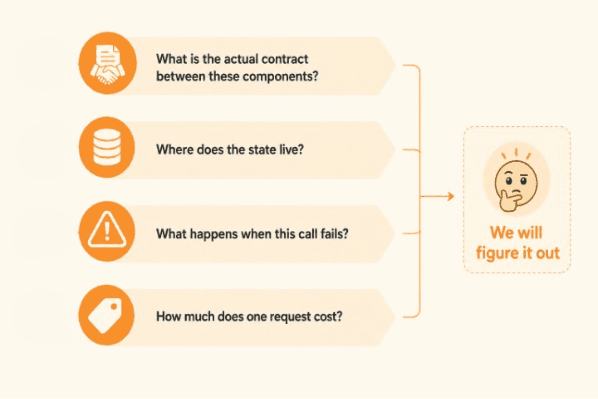
When those questions get pushed to "we'll figure it out during development," teams end up building the wrong thing very efficiently. And that's a much more expensive mistake than building the right thing slowly.
So really, a POC is inexpensive insurance against an expensive lesson. It is the difference between learning in weeks instead of quarters, between identifying flaws during ground testing and facing failures after takeoff, just as for an aircraft.
What a POC means in the era of Agentic AI
The old-school POC was, honestly, straightforward. You had a deterministic system, a known input range, and an output you could measure. You'd show that the algorithm converged, the API contract worked, the classifier hit its threshold, and that was that - green light to start building.
Agentic AI doesn't play by those rules. An agent doesn't just respond to a prompt. It reasons, plans, picks tools, takes actions, and operates with a kind of autonomy that traditional software just didn't have. The control flow isn't deterministic anymore. The state space is huge. The output isn't one clean value - it's a whole trajectory of decisions and side effects.
Which means a POC for an agentic system isn't about whether the model can produce a good answer in isolation. It's about whether the agent can consistently make sensible decisions across messy, real scenarios, recover when something breaks, stay inside its lane, and behave predictably enough that you'd trust it in a real workflow.
A POC in this world must answer harder questions.
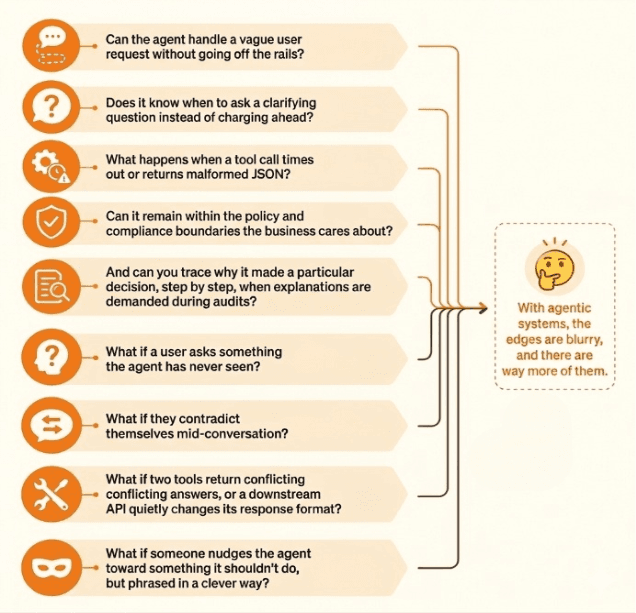
In regular software, edge cases are mostly finite. You can write boundary tests, fuzz the inputs, and feel okay about your coverage.
With agentic systems, the edges are blurry, and there are way more of them.
Each of those is a different failure mode - reasoning, state, error handling, policy enforcement - and you don't want to discover any of them in production.
Empower your agentic AI model to handle the unexpected, even at the POC stage.
An agent that looks great on the happy path but falls apart from the moment a downstream API throws a 429 isn't ready, and the POC is exactly where you want to find out - while the stakes are still small.
An agentic POC is less about validating an isolated capability and more about proving that an interconnected system of capabilities can function cohesively under realistic conditions. It is a stress test for decision-making, resilience, and operational reliability, not just functionality.
Best Practices While Crafting an Agentic AI POC
A strong Agentic AI POC is not built to impress with too many capabilities. It is built to validate whether an agent can reliably solve a real business problem under realistic conditions. The focus should be on meaningful workflows, measurable outcomes, and how the system behaves when complexity enters the process. A good POC tests judgment and reliability, not just functionality.
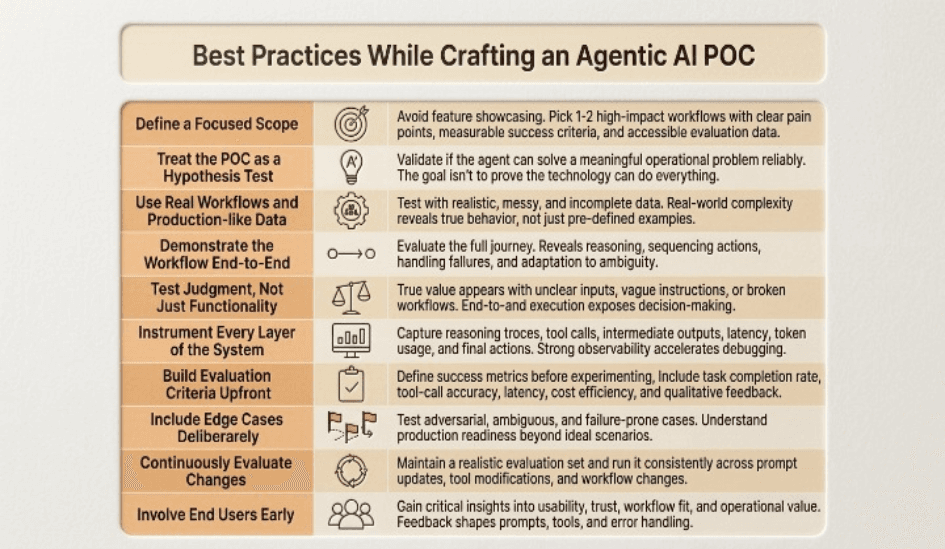
The real value of an Agentic AI POC comes from understanding how the system performs beyond ideal scenarios. End-to-end execution, observability, realistic evaluation, and user feedback reveal whether the agent is truly ready for production environments. The goal is not simply to prove that the technology works, but to prove that it can be trusted when workflows become unpredictable and operationally complex.
Critical Factors While Taking the POC to Demo
The demo is the moment the POC steps out of the engineering team's hands and into the wider conversation, and how it goes shapes everything that follows - including how much runway you'll have to keep iterating. The most useful thing to remember is that a demo isn't a performance. It's a conversation. Stakeholders aren't just watching the system work; they're quietly deciding whether to back the next phase of it.
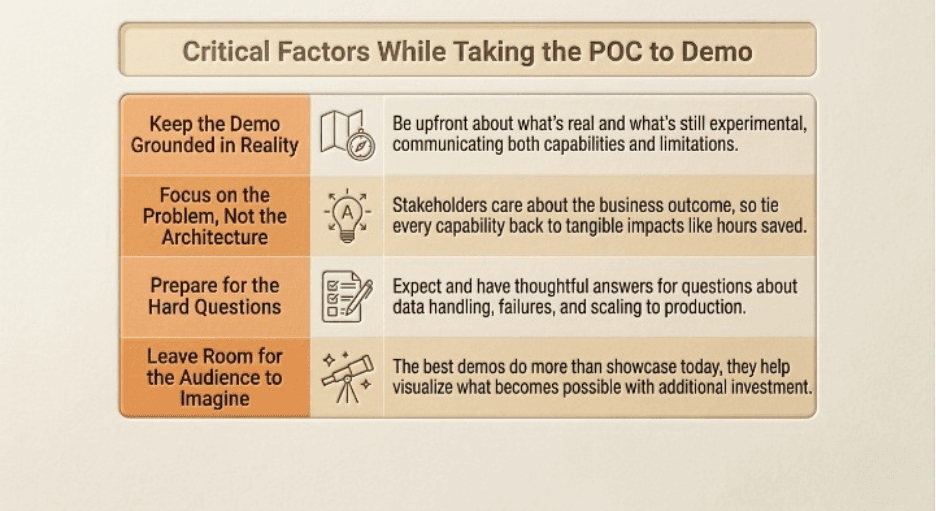
Keep the Demo Grounded in Reality
Be upfront about what's real and what's still experimental. Agentic systems can look impressive in controlled scenarios but behave unpredictably outside them. Showing only the happy path creates expectations that production systems may not meet later. The strongest demos clearly communicate both capabilities and limitations.
Focus on the Problem, Not the Architecture
Most stakeholders care less about frameworks and retrieval strategies than the business outcome itself. Tie every capability back to something tangible like hours saved, errors reduced, or decisions automated. Make the impact easy for the audience to relate to. Save deeper technical discussions for later conversations with engineering teams.
Prepare for the Hard Questions
Expect questions about sensitive data handling, failure management, production costs, and operational ownership. Even partial but thoughtful answers demonstrate maturity and production awareness. Avoiding these discussions can reduce confidence in the system's readiness. Strong demos show that the team understands what scaling to production actually involves.
Leave Room for the Audience to Imagine
The best POC demos do more than showcase what works today. They help stakeholders visualize what becomes possible with additional investment and iteration. That future-looking perspective is what drives conversations around timelines, scope of expansion, and long-term adoption. A strong demo creates momentum beyond the meeting itself.
And ultimately, the strongest agentic POC demos aren't the ones that pretend the system is complete. They're the ones that show enough value, awareness, and direction for stakeholders to believe the next phase is worth investing in.
How MoolAI bridges POC and Production
MoolAI is built specifically for this transition - that awkward, often messy space between a working POC and a production system you can actually depend on. Instead of treating the POC as a throwaway experiment that gets rebuilt later, MoolAI treats it as the first step of a continuous pipeline. The instrumentation you set up, the evals you wrote, the architectural calls you made during the proof phase - all of that carries forward into production instead of getting thrown out.
The MoolAI Platform Advantage
The platform brings together the core capabilities agentic systems need to scale reliably. It allows teams to move from POC to production without rebuilding workflows, evaluations, and operational foundations from scratch.
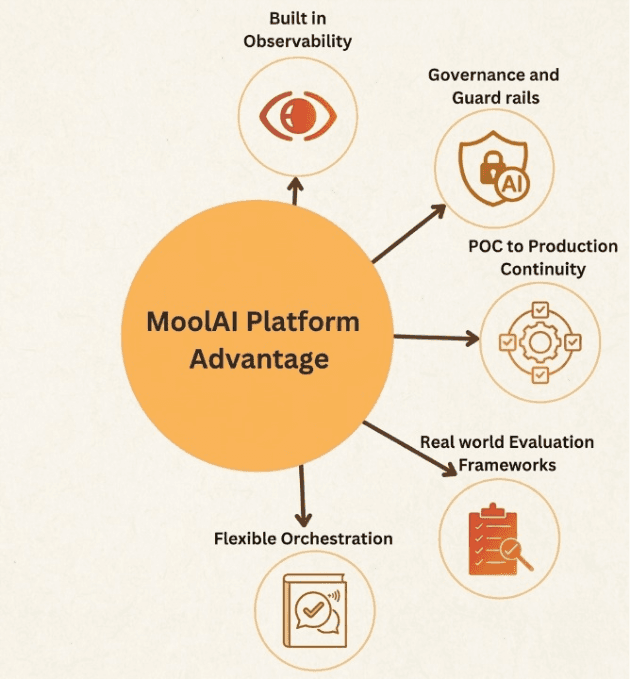
Built-in Observability
Track how agents make decisions and interact with tools in real time. This improves debugging, monitoring, and optimization at scale.
Real-World Evaluation Frameworks
Test agents against production-like data instead of isolated scenarios. This helps measure reliability and edge-case performance early.
Governance and Guardrails
Embed policy controls, compliance checks, and operational safeguards directly into workflows. Governance becomes part of the system, not an afterthought.
Flexible Orchestration
Iterate prompts, tools, and workflows without rebuilding infrastructure each time. Teams can improve systems faster while maintaining stability.
POC-to-Production Continuity
Reuse traces, evaluations, and configurations from the POC stage as the foundation for production deployment. This reduces rework and accelerates scaling.
For engineering teams working through agentic AI, MoolAI narrows the distance between prototype and production. The POC stops being a one-off demonstration and becomes the first commit of something longer-lived; a system where every iteration adds evidence, every deployment adds trust; and every user interaction sharpens what you’ve built.
Conclusion
A POC is the curtain raiser, not the full performance. Its role is to test ideas, surface risks, troubleshoot challenges, and reveal what the real path forward looks like. In the era of agentic AI, where systems are increasingly autonomous and capable, the importance of a well-executed POC has grown significantly. It’s no longer enough to prove that a model can generate responses - teams now need to prove that an agent can reason effectively, recover from failure, and operate within defined boundaries.
When done well, a POC saves time, exposes risks early, aligns teams, and creates the foundation for a production system people can trust. When rushed or skipped entirely, organizations end up building on assumptions that production environments eventually expose - often at the worst possible moment. The teams that approach POCs with discipline by keeping scope focused, instrumenting systems properly, and evaluating outcomes honestly are the ones that successfully turn agentic AI from an interesting concept into a reliable business capability.
The curtain only rises once. Make the rehearsal count.
MoolAI narrows the gap between proof of concept and production by bringing a production-first mindset to every engagement, from demo to deployment.
Table of contents
What is POC (Proof of Concept)?
Why Is a POC Essential for Any System - What Happens When a POC Is Skipped?
What a POC means in the era of Agentic AI
Best Practices While Crafting an Agentic AI POC
Critical Factors While Taking the POC to Demo
How MoolAI bridges POC and Production
Conclusion
Build agents. Trust their outputs. Scale confidently.
MoolAI ensures every AI agent is reliable, governed, and ready for enterprise deployment.
Book your Demo
