The Era of Automated FDEs: Redefining Workforce Investment the MoolAI Way

In the IT domain, nearly two decades ago, when the vacancy-to-job-seeker ratio was significantly high, procedures, concepts, strategies, and screening processes for hiring had to be made systematic. As enterprises evolved, functioning as teams became the widely adopted working methodology, enabling transparent and effective sharing of ideas to arrive at the best decisions. This created the need for consultants, specialists, and experts to work alongside the productive workforce handling routine tasks.
Traditional enterprise operations relied heavily on large teams, making hiring, onboarding, training, and workforce management a major investment area. AI-powered hiring solutions emerged to automate repetitive recruitment tasks and improve workforce efficiency.
In recent times, the workforce itself is increasingly becoming AI agents dedicated to specific tasks, and Automated FDEs are now being widely discussed as the next step in Enterprise AI systems.
It is no longer about months of implementation involving repeated discussions, reviews, alignment processes, and increasing headcount.
Automated FDEs can design and deploy AI systems within weeks, drastically reducing the need for hiring and workforce management. At MoolAI, this is exactly what is guaranteed.
Learn more from the blog below.
Understanding the Traditional FDE Model
An AI prototype that is production-ready is what an FDE works on. This requires consistent interaction with customers, aligning builds based on requirements, and coordinating with engineering teams. Carrying prototype configurations to the production level, with the required customization to work precisely within a specific environment, is the responsibility of FDEs.
This demands technical expertise, analytical skills, and excellent coordination capabilities.
In a nutshell, FDEs need to:
Collect customer requirements
Discuss requirements with the engineering team
Build the first prototype
Showcase it to clients
Troubleshoot and make improvements
Deploy it within the environment
Altogether, FDEs are the driving force behind agent building and deployment processes and are expected to stay aware of updates across end-to-end business workflows.
This model worked effectively for modern SaaS evolution. However, it also posed certain limitations, such as complete workforce dependency, which can at times be error-prone and ultimately lead to longer deployment and update cycles.
What if FDE roles and responsibilities were transformed into completely automated solutions?
Automated FDEs eliminate the prolonged gap between prototype and deployment by enabling real-time, production-grade workflow orchestration, integration, governance, and execution within enterprise environments.
The future is no longer about developing prototypes and later transforming them into production systems. Instead, it is about building production-ready, AI-native solutions from day one through autonomous execution.
Achieving this level of automation requires a comprehensive build process powered by cutting-edge technologies that deliver highly reliable, foolproof solutions while significantly minimizing workforce management efforts and operational investments.
What are the capabilities of Automated FDEs?
Here we have carefully listed what an automated FDE is expected to display so that the conventional prototype building, before actual deployment in the user environment, can be completely removed.
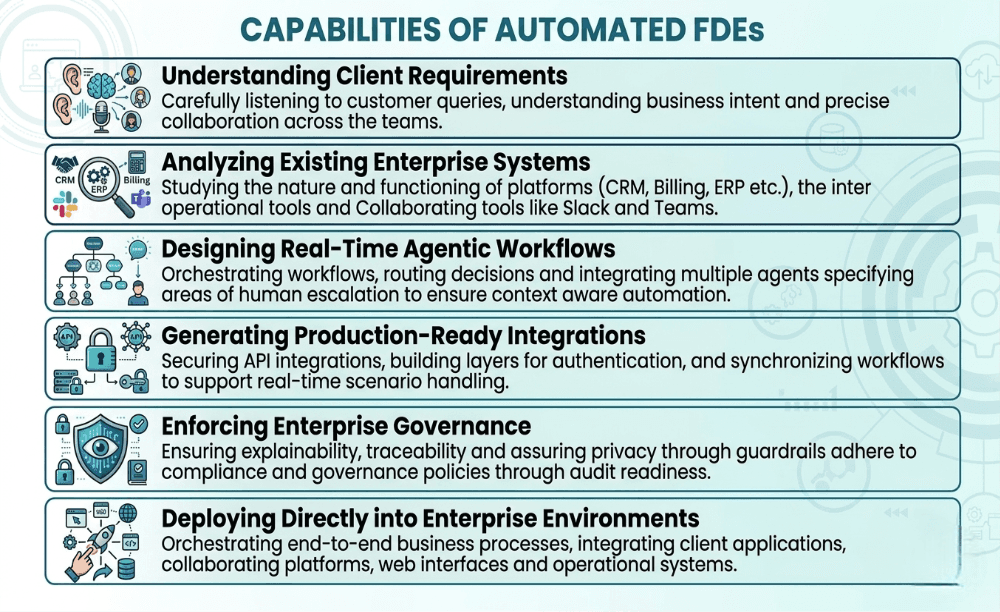
An efficient Automated FDE can deploy and kick-start production not in quarters, but in hours. Imagine the scale of investment reduction achieved through minimized workforce dependency, reduced implementation cycles, and significantly lower man-hours.
How automated FDEs impact Enterprise Workforce Economics
In just six months, AI has crossed a critical threshold, with organizations shifting from asking “Should we adopt AI?” to “How fast can we scale it?”
The KPMG Q3 2025 AI Quarterly Pulse Survey reveals that AI agent deployment has nearly quadrupled, with 42% of organizations having deployed at least some AI agents, up from 11% just two quarters ago.
These statistics highlight the rapidly growing adoption of AI agents for enterprise deployment, gradually reducing dependency on prolonged demo and prototype phases and paving the way for direct production-ready deployment.
While human intervention cannot be eliminated entirely, routine and repetitive tasks can now be executed faster and with greater accuracy through workflow-specific AI agents. Integrating these agents across workflows enables enterprises to manage complex operational processes more efficiently. Wherever human expertise is required, AI agents can intelligently redirect workflows to the appropriate teams and seamlessly resume execution once the intervention is completed.
This approach helps optimize workforce utilization without compromising the value of human expertise where critical decision-making or strategic involvement is necessary. As a result, enterprises can achieve higher operational efficiency, faster deployment cycles, and improved business outcomes.
The table below highlights some of the major benefits Automated FDEs bring to enterprise deployment workflows.
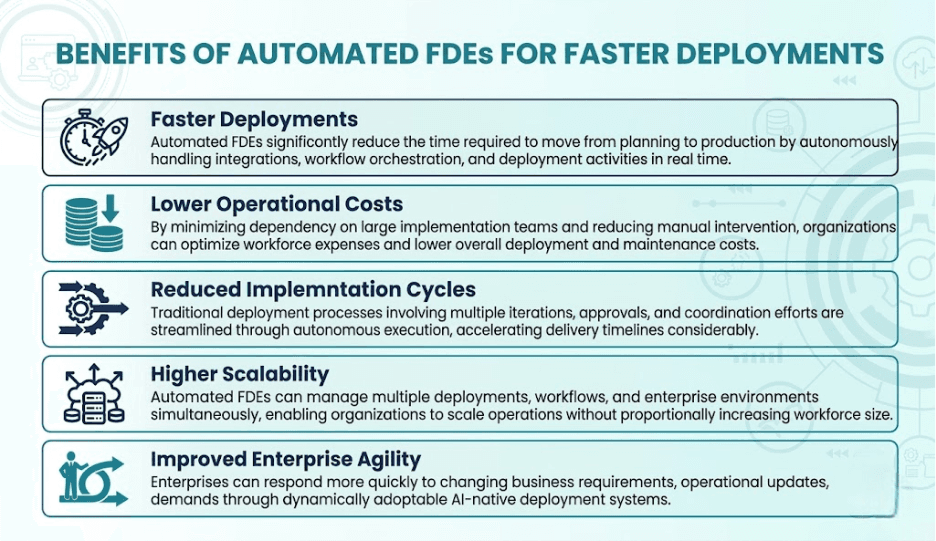
Automated FDEs considerably reduce investment in hiring and maintaining large workforces, as strategically built AI agents can perform many operational tasks more efficiently with primarily initial implementation costs. This ultimately improves enterprise economics through optimized resource utilization, reduced operational expenses, and faster execution cycles.
The MoolAI Approach to Autonomous Execution
At MoolAI, Automated FDEs are powered through a combination of context intelligence, deterministic orchestration, and autonomous deployment systems.
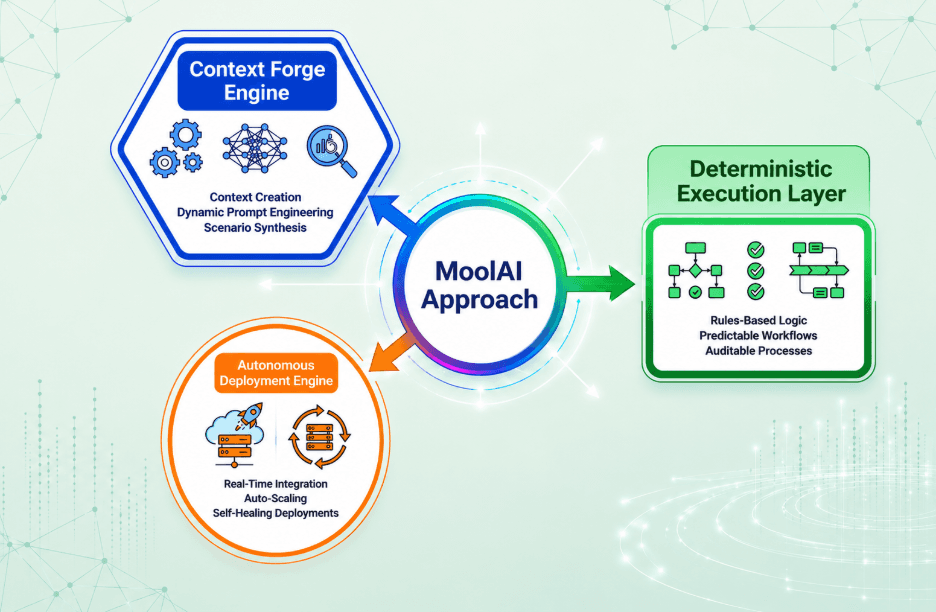
Context Forge Engine
MoolAI’s Context Forge engine captures organizational intelligence across structured systems, unstructured Enterprise knowledge, operational workflows, and cross-platform dependencies. This enables AI agents to operate with enterprise-grade contextual understanding rather than isolated prompt-level reasoning.
Deterministic Execution Layer
Enterprise AI cannot rely on unpredictable behavior. MoolAI’s deterministic execution framework ensures explainable actions, Auditable workflows, Governance enforcement, Security compliance and reliable orchestration. Every AI-driven action remains transparent and enterprise-safe.
Autonomous Deployment Engine
The deployment layer transforms workflows into operational AI agents capable of functioning directly within enterprise ecosystems. This accelerates the Integration setup, Workflow deployment, Operational automation, and Enterprise scale rollout.
What previously required months of implementation effort can now happen in dramatically compressed timelines.
Conclusion
Enterprise software is entering a new operational era. The future of product deployment is no longer dependent on endlessly expanding workforce structures. It is moving toward autonomous execution, and that’s what automated FDEs are capable of.
This shift is fundamentally changing enterprise economics from: “Scaling through workforce expansion” to “Scaling through autonomous execution.”
And MoolAI is building that future today.
Table of contents
Understanding the Traditional FDE Model
What if FDE roles and responsibilities were transformed into completely automated solutions?
What are the capabilities of Automated FDEs?
How automated FDEs impact Enterprise Workforce Economics
The MoolAI Approach to Autonomous Execution
Conclusion
Build agents. Trust their outputs. Scale confidently.
MoolAI ensures every AI agent is reliable, governed, and ready for enterprise deployment.
Book your Demo
